


Special Report: MARCO RUBIO DEFENDS WESTERN CIVILIZATION
SPECIAL TO PUBLIC ADVOCATE
CLIFFORD
F.
THIES
Professor
of
Economics
and
Finance
Theis writes in part:
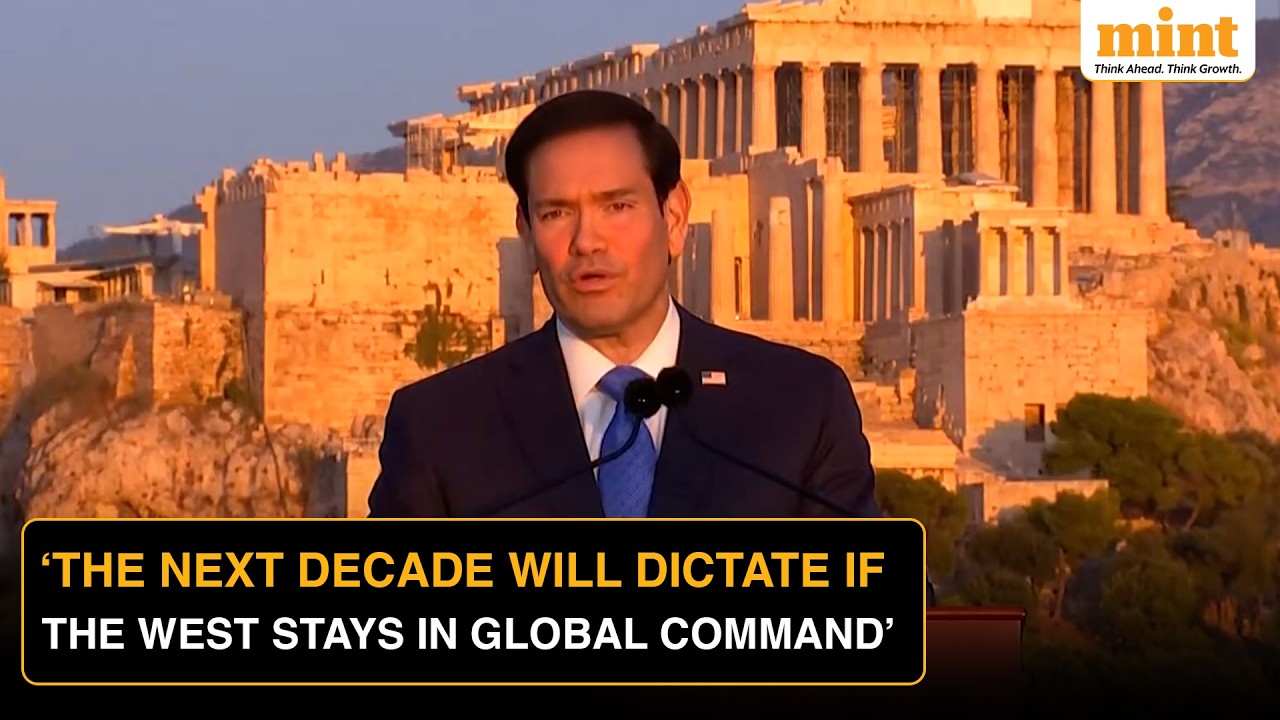
Secretaries of State are required to say nice things about the countries they visit. Marco Rubio said great things about Greece when he concluded his recent visit to that country. Here is a three minute excerpt:
A couple qualifiers: Rubio was wrong to include Alexander the Great in his list of heroes. Alexander the Great, like Napoleon Boneparte, was a conqueror. Maybe he wasn't as evil a conqueror as Ghengis Khan, and certainly he wasn't as evil a conqueror as Adolph Hitler, but there should be a chasm between those who exercise force in defense and those who exercise force in offense.
I'm not going to say Rubio was wrong to put Aristotle and Plato and, for that matter, Aquinas and Augustine on the same level. I'll say Rubio could have been more careful. It is a very good thing that these thinkers lay out a range of views allowing us to consider matters and decide our own opinions. But, between the original pair, Aristotle was correct and between the later pair, Aquinas was the more rational and Augustine the more passionate.
In a sense, Rubio made the point I have just made about Aristotle when he (Rubio) said, toward the beginning of his speech, that the Greeks informed us that the unknown could become known and, so, brought math, science and philosophy into the world.
About a third of the way through, Rubio hit a home run when he said the Greeks honored the pursuit of excellence. In contrast, today, we suffer from the pursuit of mediocrity. Today, we're supposed to feel guilty for our prosperity. Why didn't we leave a few things like the radio or the airplane for non-western people to invent?
About two-thirds of the way through, Rubio hit back-to-back home runs when he (1) distinguished between mutual benefit and self-sacrifice and (2) distinguished between glory and self-sacrifice. We economists are steeped in mutual benefit. We are ingrained with the idea (a) that securing property rights, the value of money and trade promote mutual benefit. So, while it may be tempting to redistribute wealth, it is self-destructive.
We economists are also aware (b) that honesty is the best policy. That the discipline of continuous dealing in the marketplace inclines us to actually deliver value and to seek fairness in the resolution of gray areas in our contracts and relationships.
As for glory, Rubio talked about Socrates and his willingness to speak to the truth at the cost of his own life, and of the willingness of the 600 Spartans to defend Greece against invasion at the cost of their lives. Yet, our heroes do not worship death, said Rubio. Rather, they give their lives, if this is necessary, for an even greater value.
To this I would add something that General Patton said, no bastard ever won a war by dying for his country. You win a war by letting the other bastard die for his country.
We are very much aware that a government strong enough to defend you is often a government strong enough to rule you. The political challenge is designing a government that defends but doesn't rule..............................